
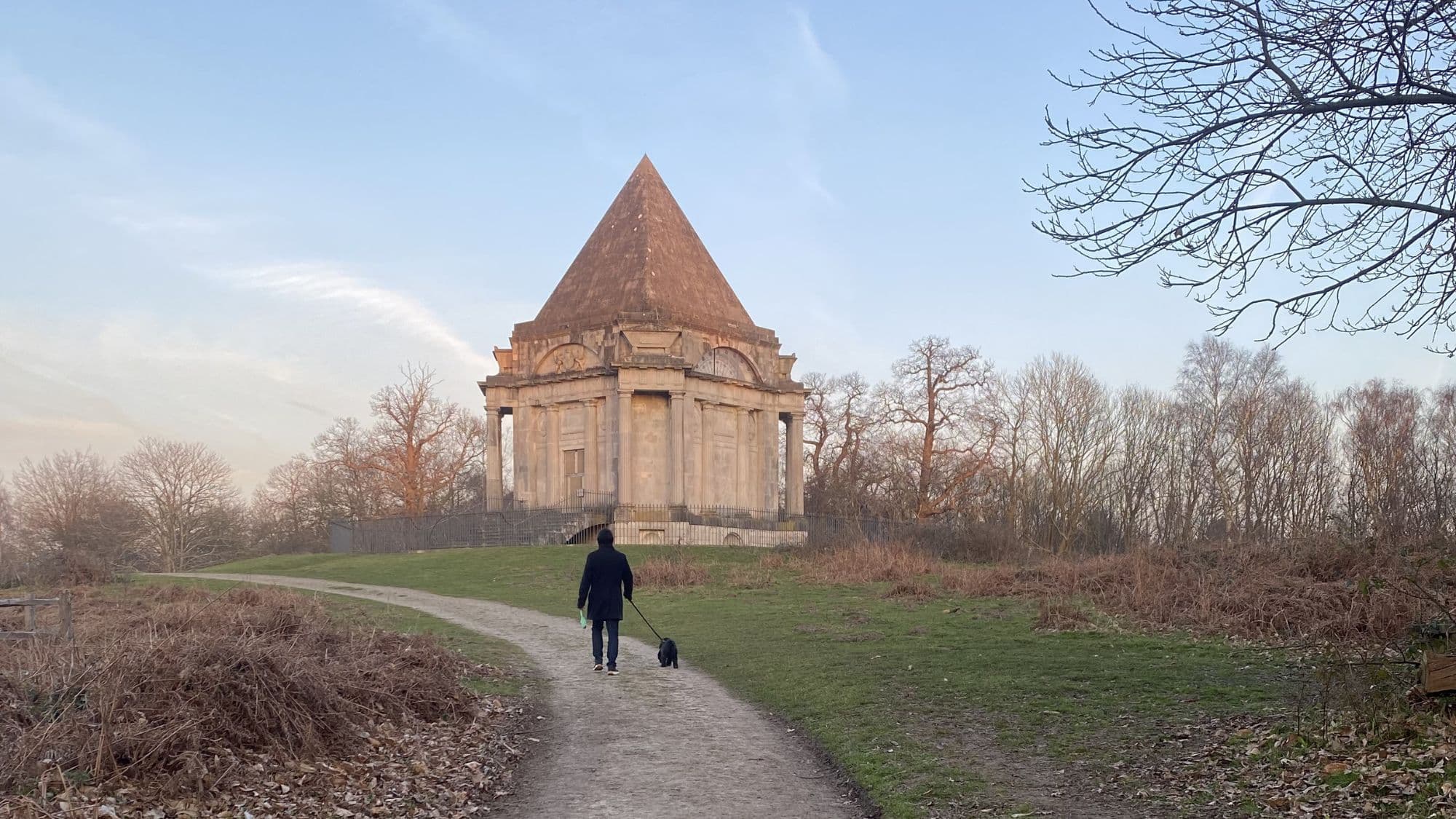
The Mausoleum in the Woods
Deep within Cobham Woods, a quiet path leads to an unexpected monument. A neoclassical mausoleum that stands as the last visible trace of a vanished estate.
There are many ways through Cobham Woods in Kent, and once you find one that suits your needs and personality, you find yourself returning to that familiar path time and time again. Just a short drive away from Medway, ours is a route travelled in most seasons. The late afternoon sun is warm enough to wear a T-shirt. The sound of car engines quickly disappears, replaced by the quiet crunch of the dry gravel path, rough under the soles of walking boots, kicking up fine dust. The path remains fairly steady, with only the gentlest incline when approaching from Cobham village. Passing the neat row of cottages, the trees and shrubs begin to thicken, and the light filters through the trunks like ribbons. Beyond the gated farmhouses, the air begins to cool as the woods hold on to their own weather in late summer.
Looked after by the National Trust, Cobham Woods is not manicured parkland nor a destination with toilets and café facilities. You won’t find signposted circuits, coloured posts indicating routes by fitness level, nor carefully framed viewpoints. That is the beauty of Cobham Woods: it feels less like a piece of nature shaped for the accidental explorer and more like a corner of the Kentish countryside that tolerates a more intrepid visitor to walk and breathe its natural splendour. Here you find sheep and ewes grazing in the late-day warmth across vast fields, horses peering over tall hedgerows that divide the path from pasture, or (if fortunate) a brief glimpse of the almost fabled Highland cow.
Just when you think the path through the trees has given way to the slightest flicker of open light, you reach a lone building on a hill in a clearing where the path curves gently to the right and the sky opens above you. The Darnley Mausoleum, built in the eighteenth century, though never used for interments, commands the highest point on what was once the Darnley family estate, finely constructed from Portland stone. Once, its pyramid roof could be seen from far and wide; it sits alone among towering trees, its stone weathered and its doors rarely opened, now just a symbolic reminder of a grand past.
The parkland has long since fragmented, leaving the mausoleum a relic of a much larger vision. Today it is a landmark sought by walkers, photographers, and the quietly curious, people who may not know its history but recognise something significant among the trees of Cobham Woods. Most visitors approach slowly, almost in awe, as if the building might reveal more the quieter their footsteps become. Dogs circle the base, sniffing curiously at the protective iron fence, while children run around once, then twice, before stopping abruptly when they realise there is no way inside.
Up close, the stone is colder than expected. The stairs remain damp even in late summer, pooling stagnant water. Peer through a crack and the interior appears hollow and dim, the late sunshine making it difficult to see beyond shifting shadows across the dust-covered floor and the faint smell of stale, age-old air.
Constructing a monument of this scale deep within woodland would have required enormous labour, hauling materials across what was once open grazing land and parkland. The surrounding trees have since grown and reclaimed the space, softening the original grandeur into something almost accidental.
Walking back toward Cobham village for a quick pint at The Leather Bottle, a glance over the shoulder and the mausoleum no longer feels like a destination but more like a marker, a reminder that this landscape once operated under different rules. As the path bends and opens into the fading evening light, it is almost as if the building had never been there at all, yet it remains etched in the mind, waiting for the next visit.