
Pie & Mash in Rochester: A Tradition That Endures
For pie and mash in Rochester, Cathedral Pie House on Rochester High Street remains one of the few places still serving the dish in its traditional form. A place-led look at its history and appeal.
It’s a sunny winter’s day and the shadow cast by Eastgate House is slowly enveloping the parade of shops opposite, where it towers above the high street in Historic Rochester. It’s Saturday afternoon and the town is buzzing, gentle chatter rising and falling as people drift between doorways. Peering through the glass frontage of Cathedral Pie House, it’s evident that today is a busy one.
It is one of the few remaining places for a classic pie and mash shop in Rochester, still serving the dish much as it has been for generations.
Weekdays are made for lingering, a steady crowd drifting in and out in its own rhythm. Saturdays are different. The bustle inside is typical for a winter weekend.
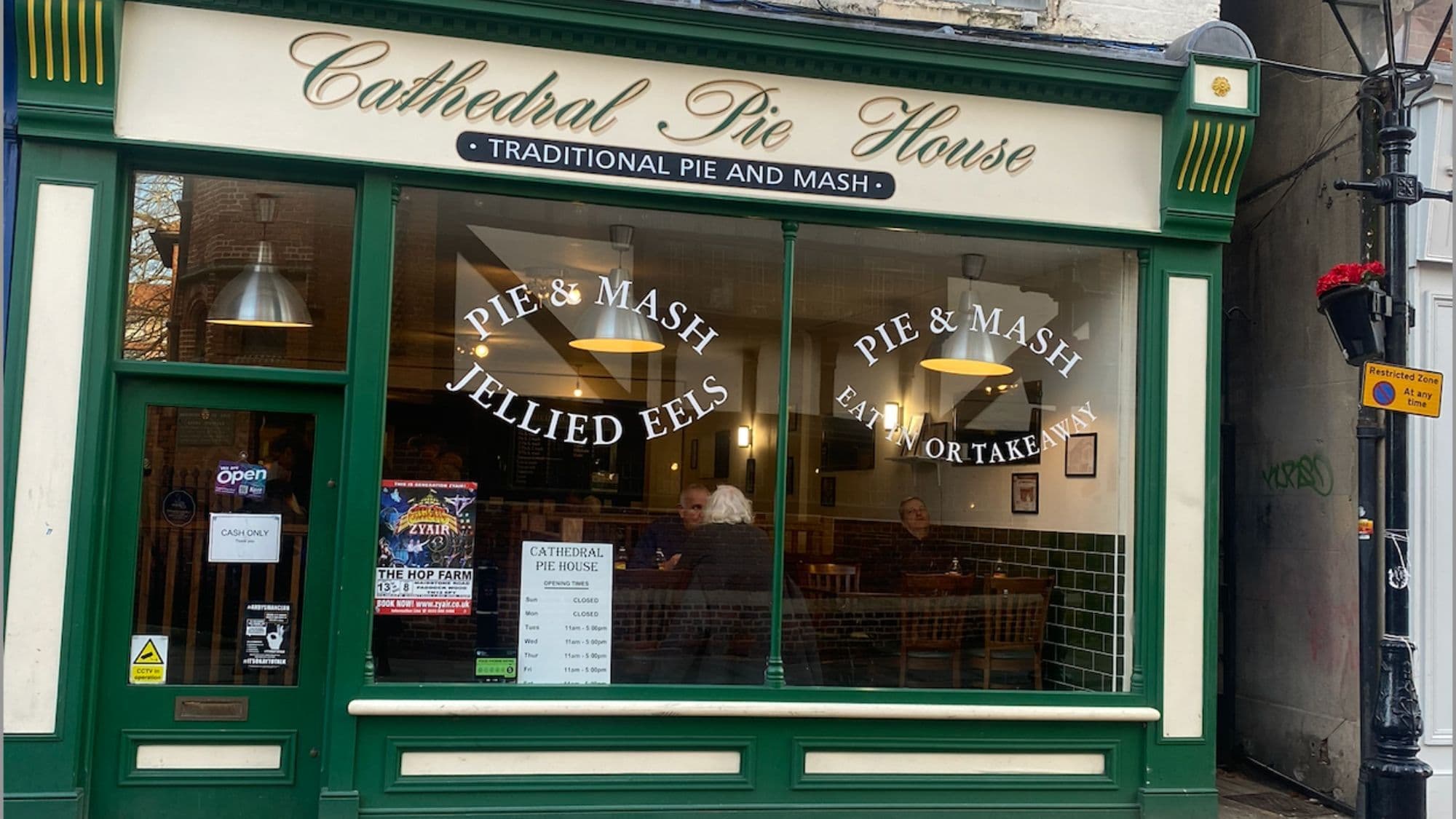
Cathedral Pie House stands proudly in decorative racing green, creams and touches of gold. A large sign declares 'Pie & Mash - Jellied Eels', ensuring you know you’ve reached your destination. Open the door and the heat gently drifts out into the cold. It’s comforting to see the familiar glossy green tiles racing halfway up the walls, the uniform look of most traditional pie and mash shops.
Though busy, nobody raises their head. They are too intent on their plates of hearty fare. Forks and knives tinker against porcelain, each plate creating its own soft musical note beneath the low hum of conversation.
The menu offers little choice. Tea, coffee or soft drink. Either pie and mash or mash and eel, and you are either team gravy or team liquor.
Liquor is a unique tradition, an almost translucent, quietly thick liquid scattered with finely chopped parsley. And the taste? Parsley.
The pies, like pork pies or Cornish Pasties, can only truly be made one way here: minced beef and onion, with slight moisture but generally drier than you might expect. That is where the liquor comes into its own. Depending on the mood of the chef, the mash will either be smoothed to near-perfection or left slightly textured. You rarely get the latter here.
That is why visits begin to feel like ritual. Its up to the diner how much vinegar, salt or chilli they apply.
There is an art to the presentation of pie and mash on the plate. It is not about decoration, but about skill and precision. The way a portion of mash is smoothed and knifed to one side of the plate, how double pies are neatly arranged, how just the right amount of liquor is poured. It’s these small details that separate long-rooted traditional establishments from newer pie and mash shops.
There is a style and technique to it. Here, it feels assured.
As you look around, there is a clear generational mix: older regulars sitting alongside grandchildren continuing the tradition and those who are aged in between who “just love a Pie and Mash”. Others are obviously here for their first plate, studying the meal with quiet curiosity before committing fork to crust.
Pie and mash is a working-class tradition with roots in the docklands of nineteenth-century East London, where labourers needed food that was served fast, was warm and also affordable. Eels, once plentiful in the River Thames, were a cheap staple; used to fill pies or served stewed, baked or jellied, an acquired taste. They were sold from street market stalls and by travelling pie men.
As the Thames became more polluted and demand increased, eels were imported, often arriving by Dutch boats. Beef pies gradually became the centre of the meal, as they remain today, served alongside mash and a parsley-flecked liquor made from eel stock. A combination designed for sustenance rather than refinement. Extra portions were often taken home, extending a single purchase into a family meal.
By the late nineteenth century, permanent pie and mash shops began to appear across East and South London, later spreading into other parts of London, Essex and Kent. With their large windows, tiled interiors and simple marble counters, they offered inexpensive hot food served quickly and consistently. The original fast food in its most practical form. For many neighbourhoods, the pie and mash shop became a familiar fixture of everyday life. Some of the few that survive today still retain their original interiors. Tiled walls, long marble counters and large glazed windows little has changed over the century.
Once found in their hundreds, fewer than forty traditional pie and mash shops remain in London today. Rising running costs make survival increasingly difficult, while High Streets now offer far greater variety and changing tastes have shifted everyday habits.
Food culture has expanded, bringing new cuisines and different expectations of the dining experience, often accompanied by more stylised interiors. At the same time, growing awareness around health and diet has made suet-based pastries and richer meats less central to daily eating.
The result is not sudden disappearance, but gradual decline: fewer marble counters, fewer tiled rooms, fewer places where the ritual continues as it once did.
In a landscape where many have disappeared, places like this feel increasingly rare. Cathedral Pie House continues the tradition in every detail, from the interior to the menu and its cash-only policy – rare in a increasely cashless world.
Though the offering is simple, there is a steadiness in what arrives on the plate; little has changed in how the meal is prepared or served. Looking around at the other diners, the appeal clearly spans generations, older regulars alongside families, the weekly visit continuing much as it always has.
Like gypsy tarts or other regional staples, pie and mash forms part of the everyday food heritage of the places where it survives. It offers continuity in a High Street that is constantly changing, it’s something familiar that does not any need explanation.
If you are fortunate enough to have a pie and mash shop nearby, it is part of the weekly rhythm of the community, a place where generations return without ceremony or reinvention.
Not everything needs to evolve to remain relevant. Some traditions endure simply because they continue to serve a purpose.
Back outside, Rochester High Street has quietened. The light has dipped as we walk back towards the castle, the warmth of the Cathedral Pie House shop gives way to the cool evening air.