
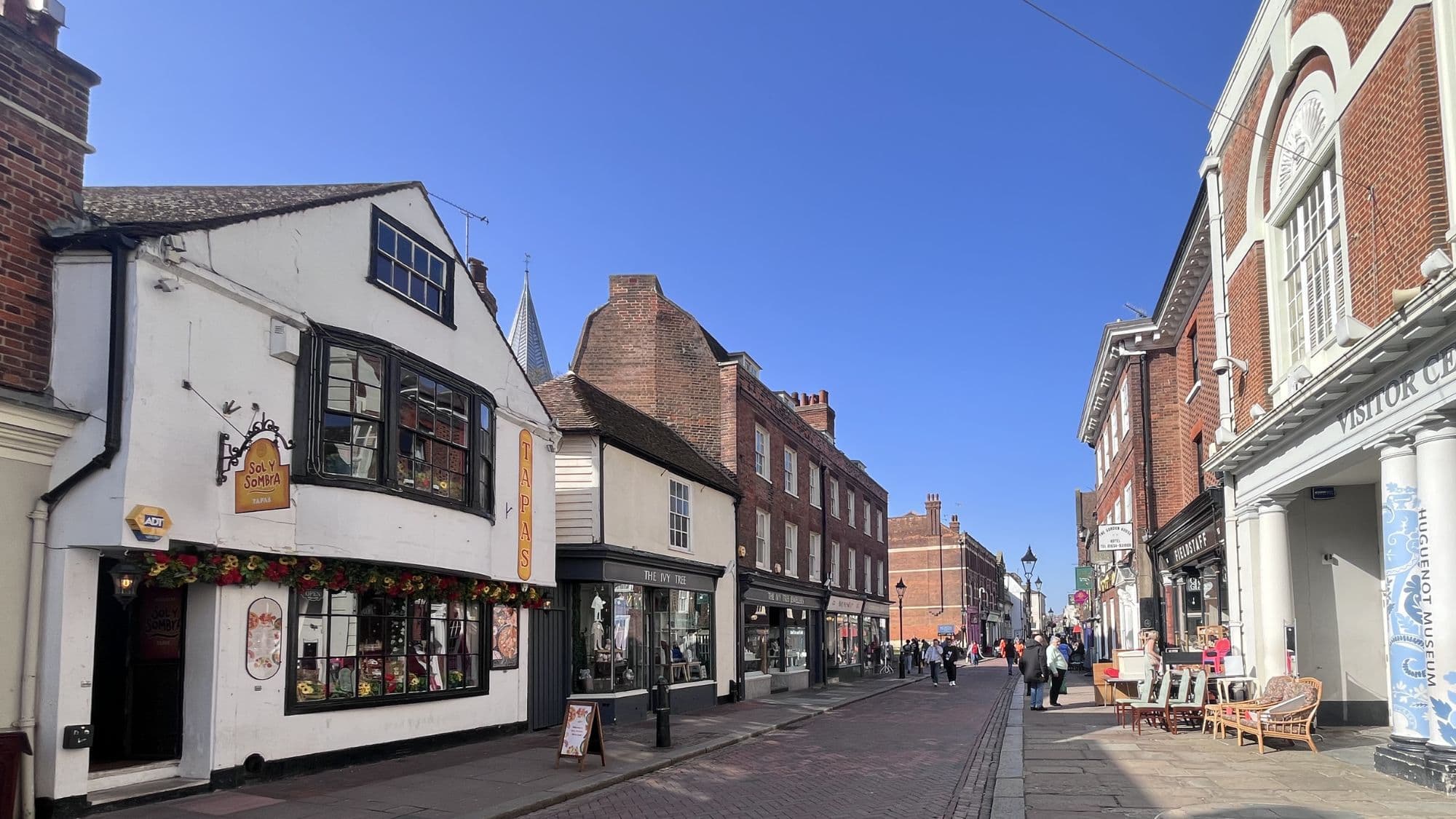
Rochester High Street
Rochester High Street in Kent brings together independent shops, cafés, historic landmarks and everyday local life along one of England’s most enduring streets.
Rochester High Street: Character & Identity
Rochester High Street is not simply a destination but one of continuity. It is a place where everyday life has continued across the centuries without the need for reinvention. Positioned at the bridge crossing of the River Medway, it has long been as much a route through as a centre, guiding trade, commuters, shoppers and neighbours along the same narrow corridor of buildings. What distinguishes it from many high streets is not grandeur, nor how well preserved the buildings are, but its persistence. For those visiting, Rochester High Street forms a natural centre, connecting shops, cafés, historic landmarks and everyday life along a single walkable route.
Businesses change hands rather than disappear, often staying within the same families for generations or passing to owners with longstanding ties to the area. Others return after years away, drawn back by a familiarity that is difficult to explain. The result is a high street with an atmosphere that feels quietly assured, lively without being hurried, historic without feeling preserved. It is not a street that performs for visitors, but one that continues regardless of them, shaped by the people who keep showing up day after day.
History of Rochester High Street
Once a centre of power, medieval Rochester was an important fortified city, marked by its strategically placed Norman castle built on the remains of the earlier Roman fort and cathedral complex. A royal stronghold, the area endured repeated sieges and long periods of instability. Yet the High Street continued when power shifted elsewhere.
Rochester High Street has always quietly endured. Even the closure of Chatham Dockyard in the mid-1980s, which brought significant economic decline to Medway and the fading of Chatham High Street as the major commercial centre, did not diminish its role.
A Street that Continues
Over time it reshaped itself, building a reputation as strongly independent, with a resilient food scene. It became a hub built on slower, more sustainable activity.
The architecture reflects this continuity. Many buildings from earlier prosperous periods remain standing, preserved, adapted, and still in use today. They do not present a single era but a layered history at street level. When Charles Dickens returned to the area later in life, he found much of the same rugged character that had first sparked his imagination. He walked these streets for miles each day, drawing on textures, contrasts, and the lingering sense of a place that had once held great power and now continued in a quieter form.
Daily Life on Rochester High Street
The High Street remains busy throughout the day, less shaped by visitors than by the routines of the people who rely on it.
Morning Movement
In the morning, commuters and schoolchildren use it as a scenic route through town on their way to catch trains or buses, forming a steady current of familiar faces. It is the backbone of everyday movement rather than purely a destination in itself.
Afternoon Pause
By afternoon the pace softens. Shoppers move between High Street names such as Austin’s Farm Shop and C.J. Hook & Sons, alongside cafés and smaller shops, picking up groceries and everyday necessities. Parents meet over coffee, sometimes lingering in bookshops where there is space to sit and talk. Regulars stop for weekday lunches, catching up with owners who know them by name.
Evening Gatherings
Evenings bring a different kind of gathering. The pubs fill, as do restaurants and cafés. Quieter spaces designed for meet-ups come into their own. What emerges is not just nightlife in the usual sense but a continuation of community, people meeting after work, marking occasions, or simply spending time together in a place that feels shared and familiar.
Just across the bridge, the rhythm shifts as Strood opens into a stretch where everyday shops and larger stores become the focus, with residential streets extending out beyond them.
Independent Shops & Local Businesses
Independent shops across retail and hospitality define Rochester’s High Street. National chains are present but only in small numbers, something many locals regard as a strength. The street’s character comes from businesses run by people with deep ties to the area and a close understanding of the community they serve.
Our guide to independent shops on Rochester High Street brings together some of the smaller stores and long-standing businesses that give the street its character.
A Naturally Layered Mix
Established shops sit alongside newer ones, creating a mix that feels naturally layered rather than curated. Baggins Book Bazaar anchors the street with its maze of second-hand rooms, while nearby independent cafés such as Café Lounge and The Rochester Coffee Co. provide familiar daily meeting places. Specialist food shops, bakeries, and small boutiques like Empire and Analogue Music, offer alternatives to uniform high street retail, reinforcing the sense that this is a place shaped by local demand.
The variety reflects the diverse groups who use the street every day. University students, young professionals, families, long-time residents, and visitors can all find a place to pause at any time of day. Social venues range from traditional pubs to contemporary wine bars, board game cafés such as Playopolis, and a wide selection of international eateries. Together they create a high street that functions as a shared social centre, sustained by regular use and long-standing relationships.
Cafés, Pubs & Restaurants on Rochester High Street
Rochester High Street offers many places to settle rather than a single defining venue. Cafés, pubs, and restaurants form the social glue of the street, somewhere to pause between errands or linger long after plans are made. Olé Rochester encourages relaxed conversation over small spanish tapas plates, while long-standing Italian favourites such as Amore and Mama Mia draw regulars back for familiar, generous meals. The famously leaning Wolf & Castle serves craft beer in one of Historic Rochester’s most recognisable buildings, while The Crown continues the tradition of dependable Sunday roasts that often sell out early.
Livelier evenings can be found at George Vaults and Oliver’s, while families gravitate towards Chuck and Blade. For a quieter, more refined meal, Fish 55 offers seafood-led dining. Together these places sustain the everyday rituals that keep the High Street alive long after the shops close. For a detailed overview of places to eat along the High Street, see our guide to places to eat in Rochester.
Historic Landmarks Along Rochester High Street
Rochester’s High Street is shaped not only by shops and cafés but by historic buildings woven into its fabric. Eastgate House, the striking Elizabethan mansion that has served many purposes over the centuries, stands prominently along the street itself.
Towards the Cathedral & Castle
Just beyond the main stretch of Rochester High Street, a narrow passage known as Black Boy Alley slips between the buildings towards the historic Deanery Gate, one of the entrances into the cathedral precinct once used by pilgrims visiting the shrine of William of Perth at Rochester Cathedral. Passing beneath the arch, the street gives way to the quieter space of the cathedral precinct opposite the castle grounds, where the pace of the town noticeably slows.
Nearby, the Norman castle keep rises above the river, a constant reminder of the city’s strategic past. The King’s School, one of the oldest in the country, sits within this same historic landscape, while Restoration House, associated with Dickens’ Miss Havisham, lies only a short walk away opposite The Vines. Together these landmarks do not stand apart from daily life but shape Historic Rochester’s continuous backdrop.
Atmosphere of Rochester High Street
Morning & Afternoon
Morning on Rochester High Street begins quietly, like a town easing itself into the day. Shopkeepers lift shutters, keys turn in old locks, and familiar faces pass through. By afternoon the pace softens into a pattern of small errands and brief conversations as people move in and out of cafés and shops.
Weekends & Seasons
On bright weekends the street fills more noticeably, animated but rarely hurried. Buskers provide a gentle soundtrack, most memorably the saxophone player whose music drifts along and becomes part of the setting itself. Throughout the year festivals bring surges of visitors, creating a more crowded, celebratory atmosphere that briefly transforms the everyday rhythm.
Yet the street never feels dormant. Even in the quieter weeks of winter, particularly in January, activity slows rather than stops, returning to a steadier tempo that suits a place shaped by continuity rather than show.
Walking Route: Exploring Rochester High Street
Begin at Eastgate House for a gentle introduction to historic Rochester, then cross to Crow Lane where Restoration House stands opposite the quiet green of The Vines. Follow the path in this small garden into the older back streets, emerging along St Margaret’s Road past the Coopers Arms, with St Margaret’s Church on your right. From there continue towards Churchfields for a wide vantage point over the river and surrounding landscape. Descend towards the Esplanade, arriving at the open space before Rochester Castle, where the High Street begins to reveal itself fully. From here, the landscape opens out beyond the town itself. Take this route slowly, pausing where you wish, and remember to look up as often as you look ahead.
For those who would like to continue beyond the High Street, A Quiet Walk Through Historic Rochester follows a circular route from Rochester bridge, through to the riverside, cathedral precinct, castle gardens and quieter streets, accompanied by a downloadable guide and narrated audio companion.
The Enduring Appeal of Rochester High Street
Rochester is visually striking, with one of England’s best-preserved high streets, yet many places share that kind of character. What gives this one its lasting presence is the meeting of river, castle, and cathedral, a landscape shaped by centuries of influence that is difficult to fully comprehend.
The scale of history here is immense, but it is carried with a quiet confidence that is enduring. Above all, it is the people who sustain it. Open, friendly, and rooted, they give the town its sense of continuity, ensuring that Rochester feels not simply preserved but genuinely alive as a community.