
Hometown: A return to making on the High Street
A fabric shop on Rochester High Street shaped by colour, craft and workshops that bring a quiet rhythm of making.
Walking into Hometown, it’s the colour that greets you at first.
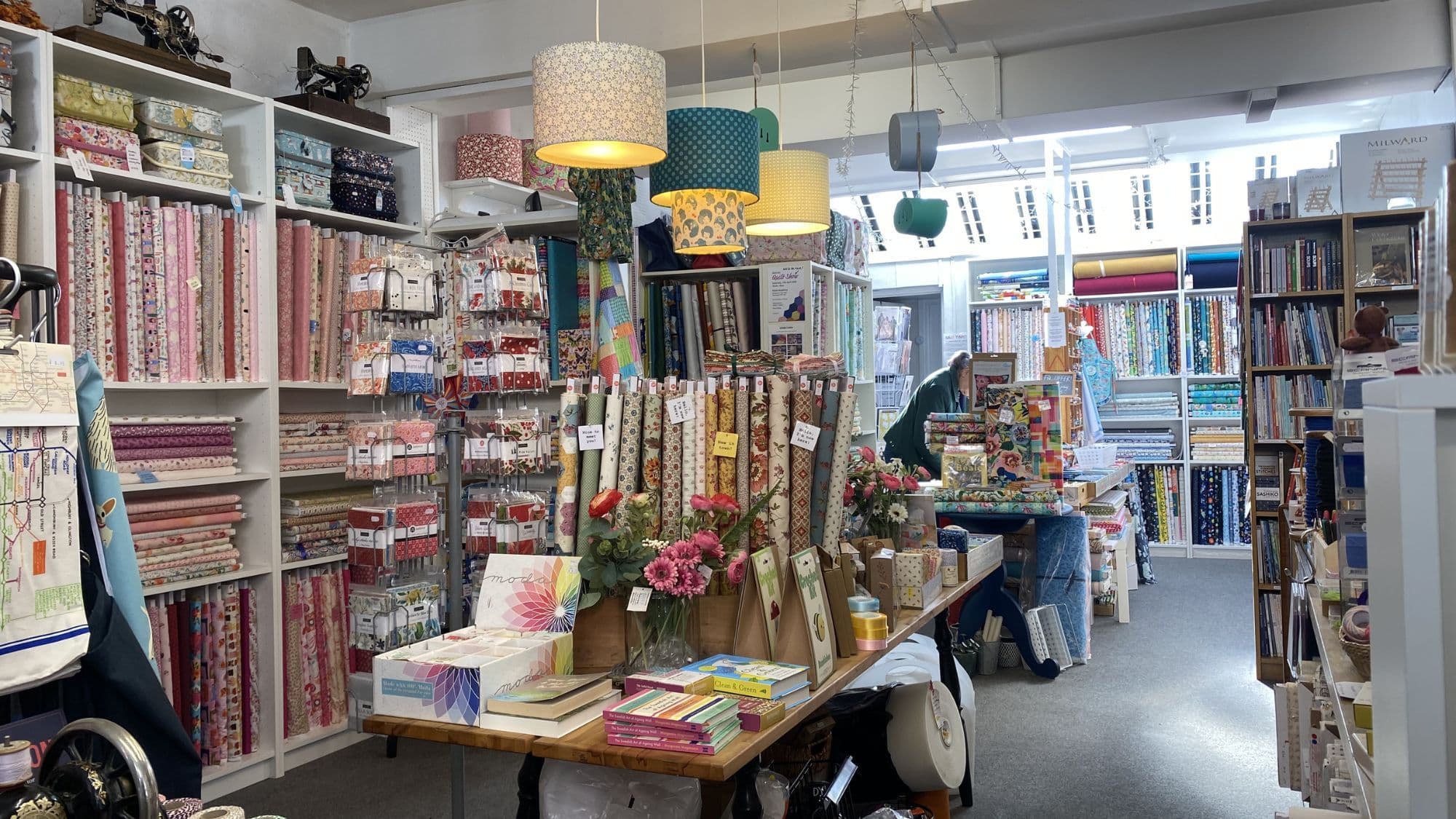
It glides across the room in a quiet order. Shelves of fabric run from floor to ceiling, arranged not just by type but by tonal family. Soft creams and whites give way to bold florals. Liberty prints sit alongside ginghams and plains, each shade placed with a careful, almost instinctive logic. It feels like library, though instead of books, it’s colour that has been catalogued and neatly stored.
At first, it can feel slightly overwhelming. Then, slowly, the space settles. Light from the skylight at the back lifts everything just enough, softening the space into something calmer. Vintage Singer sewing machines sit high above the shelves, watching over the room. Around them, quilts, lampshades, dresses and cushions rest in place. Quiet examples of what might begin within these walls.
Hometown was founded in 2008 by Marion Haslam, bringing together two strands of her life: a long career in retail and decades spent quilting. Before opening the shop, she worked for companies such as IKEA, John Lewis and Habitat, developing products on a global scale before stepping away to create something smaller and more personal.
There were other moments too. Time spent living and working overseas, including Sweden and the UAE, alongside work as a magazine editor and author. A career shaped by structure and creativity, now distilled into something more local.
The shop’s name reflects that shift. After years away, the idea of “home” became less about a single place and more about returning to something familiar. A slower rhythm, a different way of working.
Rochester wasn’t an accident. Marion had been looking for a High Street with an independent feel. Somewhere shaped by small businesses rather than chains. Places like Blackheath and Faversham. When a space became available here, she took it immediately. She was originally based further along the street, in the unit now occupied by The Cheese Room Deli, before outgrowing the space and moving into a larger one further along the High Street.
She describes Rochester High Street in much the same way she describes the shop. Something that evolves gradually rather than all at once.
“When one shop moves, or needs a bigger space, another on the street takes its place. That’s the rhythm.”
The idea carries through into Hometown itself. The large central tables, stacked with fabric, books and materials, feel less like display and more like a working surface. Beneath them, baskets of trimmings, threads and tools build into a layered system that reveals itself slowly the longer you look.
The shop is supported not just by what is sold, but by the workshops that take place downstairs. They run regularly, bringing people back into the space to learn, make and return again. Beginners start with simple projects, others build on existing skills and over time a quiet community has formed. People know the shop not just as customers, but through a shared passion for fabric and home crafts.
Like many independent businesses, things have shifted in recent years. Trade now moves in waves, less predictable than before. But the shop continues, shaped by the same steady focus of making and material.
Standing between the shelves, it becomes clear that Hometown isn’t simply a fabric shop. It’s a place built over time. Through colour, repetition and the accumulation of knowledge. A space where global experience has been shaped into something local and lasting. Where the pace of the High Street softens, briefly, into something more considered.