
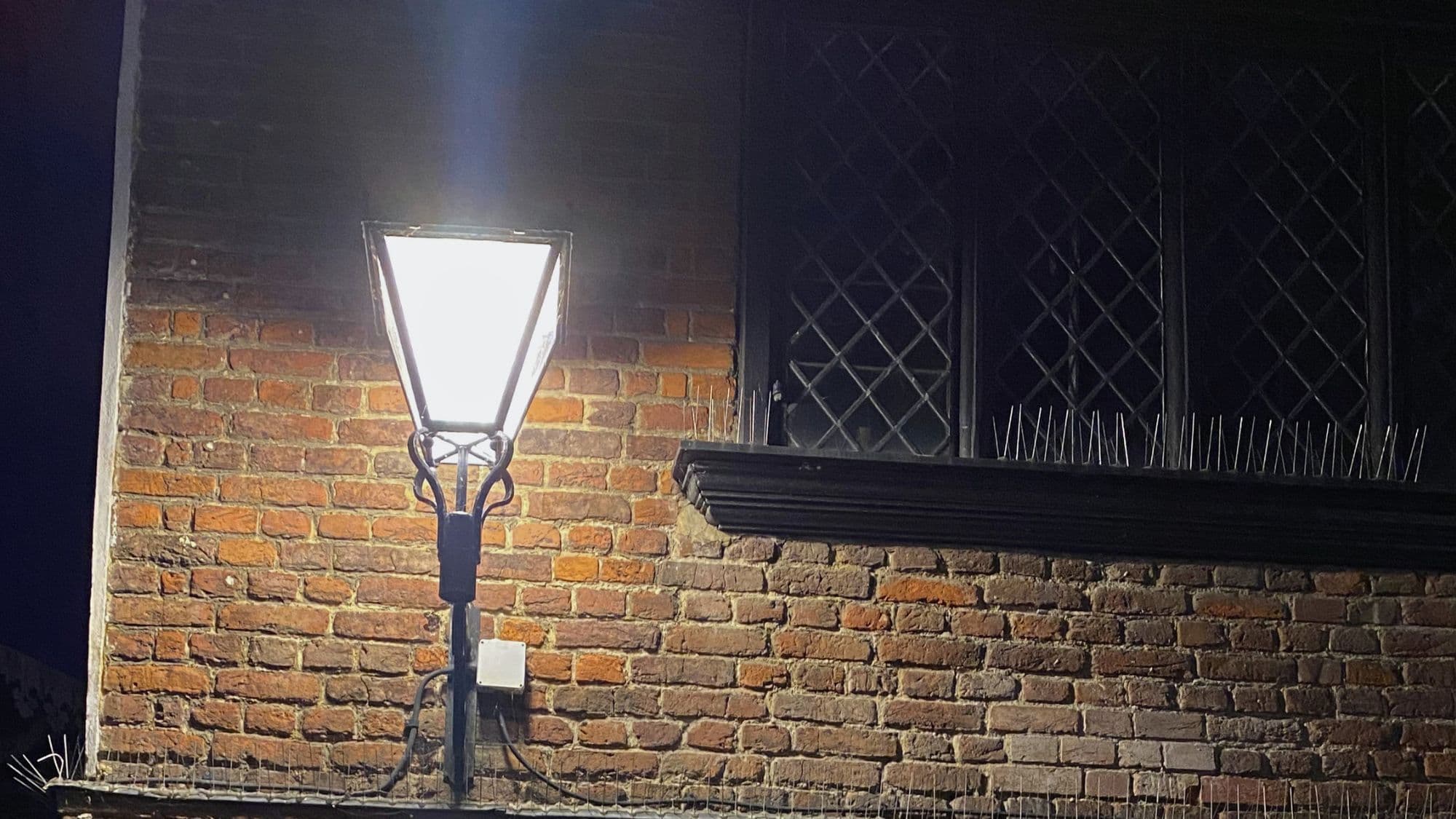
Rochester After Dark
A walk through Rochester’s darker history, from medieval records and archaeological discoveries to forgotten newspaper reports, ghost stories and folklore.
A walk that traces some of the stranger stories from Rochester’s past, from medieval account books and archaeological discoveries to forgotten newspaper reports and tales that change with each telling.
At the end of Rochester High Street, where the historic High Street begins to melt into Chatham Intra, the Nags Head is easy to pass by without a second look. Yet here, in the 1970s, something strange began to be documented in the local papers.
This feels a fitting place to delve into Rochester’s alternative past. We’re not just talking ghosts. We’re looking at traces of stories left behind in newspaper reports, written accounts found within the pages of dusty books, memorials, archaeological discoveries, folklore and tales passed down through the generations.
Some of what we uncovered is well documented. Other accounts become harder to pin down the deeper you look.
Our route starts at the Nags Head before heading back towards historic Rochester, through The Vines Gardens and into the grounds of St Margaret’s Church, before meeting the River Medway and tracing a line towards Rochester Bridge, the Castle, Cathedral and, finally, the Guildhall.
Follow it on foot if you like, but more than anything, take it as an invitation to look again, and a little deeper, at places you may already know.
Nags Head, 292 High Street
This 17th-century Grade II listed pub sits on the corner of Nags Head Lane. Part of the building at the rear was once a police station, with its holding cells in what is now the pub’s cellar.
This is where the strange story of a young woman named ‘Aggie’ begins.
Haunted Rochester (2011) reproduced a newspaper article dated 14 January 1975. There is no mention of a ghost named Aggie. Landlady Maddy Kinsella told the newspaper that around midnight her Alsatian would repeatedly begin barking at something inside the pub. Kinsella also reported the sounds of running and jumping, closed doors being found open, the cellar hatch moving and bottles falling from shelves. She also claimed to hear the voice of a young woman.
Four years later, the story had changed.
A newspaper report dated 15 May 1979 described how a Gravesend-based paranormal group called The Ghost Squad spent two nights in the pub. Their investigation was largely uneventful, although the group reported a watch stopping at 4am and heavy cylinders appearing to have moved.
By now the young woman had a name.
Aggie. Aged 17. Forced into prostitution and murdered.
The story changes again in The Paranormal Database. Aggie is now a former prostitute who took her own life.
We could find no historical evidence for either death. But the changing story gives us something a little more interesting. In 1975 we had a young woman’s voice and no name. Four years later, the voice had become a person, with a name, an age and a death.
Eastgate House
No introduction is needed for this Grade I listed Elizabethan building, built around 1590. Bought by Rochester Corporation in 1897, it opened as a city museum in 1903.
By 1938, something rather different could be found in the building’s cellar.
Newspaper reports from that year describe a ‘Chamber of Horrors’ devoted to punishment and imprisonment, initially restricted to members of the council and other privileged persons. Exhibits included prison fetters, a whipping post, part of a condemned cell door taken from the police station behind the Guildhall, a model wooden cage on a revolving platform, mantraps, thumbscrews and ducking stools.
The pièce de résistance: a reconstruction of Rochester Castle’s dungeon.
The following year, stocks and a pillory joined the collection.
Today, the Chamber of Horrors has long disappeared, with Eastgate House more closely associated with Charles Dickens, leaving this curious chapter of the building’s history largely out of sight and mind.
Nearly opposite this place
Our next tale finds us at St Margaret’s Church, where among the memorials in the churchyard stands one to a family who drowned ‘nearly opposite this place’.
On the morning of Sunday 21 June 1812, Edward Finch, the 38-year-old landlord of Rochester’s Postboys pub, took three of his sons onto the River Medway in a peterboat. They were William, 14, John, 10, and Richard, 7.
Heading upriver, a sudden squall overturned the boat. All four drowned.
The Maidstone Journal, published two days later, preserved a small detail. One of the boys managed to swim to within ten rods of the shore before his strength failed. Another was found beneath the overturned boat.
Inside, searchers found Edward Finch’s large knife. The newspaper supposed he had taken it out to cut the mainsheet, but had been too late. The same edition also reported violent thunderstorms around Maidstone that morning.
Edward’s wife, Ann, died just six weeks later. Their memorial describes her as ‘broken hearted’.
More than two centuries later, it still points us back towards the Medway: ‘nearly opposite this place’.
Where records become uncertain
A short walk from St Margaret’s is the famous Coopers Arms. The Grade II listed building dates to the 17th century or earlier, although the pub traces its history much further back, with reputed origins during the reign of Richard I and an association with the monks of St Andrew’s Priory.
One enduring legend tells of a member of the supposed ‘Brethren of Coopers’ who committed a terrible sin against his order. His punishment was harsh. Walled up alive and left to die within the fabric of the building, he is said to return once a year in November.
Later versions describe a grey-robed monk walking through the wall by the bar or moving customers’ pint glasses. Another tale speaks of a secret tunnel and a forbidden visit to see a nun.
We couldn’t find early documented evidence behind this tale. But if you fancy testing the legend yourself, enjoy a drink here one November evening and see if the monk makes an appearance.
The pub sits on the corner of Love Lane. Take this route past the little terraced cottages and alongside the curve of the ancient Castle wall. A little further on, you’ll meet an arch. Walk underneath and you’ll find yourself at the top of Churchfields, overlooking the ebb and flow of the River Medway beneath beautiful open skies.
When you’re ready, make your way down towards the river.
Good Friday, 1264
The residents of Rochester were well and truly caught in the middle of the Barons’ War. On 17 April, Gilbert de Clare attacked from the south. The following day, Good Friday, Simon de Montfort attacked from the Strood side.
The crossing at the time was Rochester’s older Roman-origin bridge. Defenders removed planks from part of the crossing and the first attacks were repelled. Then a fireship was sent towards the bridge, loaded with wood, pitch, coal, sulphur and pigs’ fat. The bridge defences caught fire. The attackers crossed. Rochester was captured and looted.
On Easter Sunday, 20 April, the fighting paused. The garrison consumed eight sides of bacon, four and a half oxen, eight sheep and 1,400 eggs. The fighting resumed the following day.
It’s funny what survives centuries later. In this case, an account book records those 1,400 Easter eggs alongside another small expense: sixpence spent ‘on burying a dead man’.
Nearly six centuries later, the ground around Rochester Castle produced another story.
Part of the Castle ditch had been acquired by St Nicholas Church for use as additional burial ground. Some of its monuments survive today. In 1842, labourers were levelling the ground when they discovered something beneath it.
The Maidstone Journal of 24 May recorded the discovery of ‘a number of sculls, & other human bones’ just a few feet below the surface.
Here’s the interesting part. They didn’t know whose bones they had found. Even then, their origin was described as a matter of ‘interesting conjecture’.
Today, headstones still lean against the Castle walls while the grass around them has become a place where children play.
Beneath the Cathedral
Across from the Castle is the Cathedral precinct, where some of Rochester’s more unusual historical stories lie right beneath your feet.
The year is 1327. There was a long-running dispute between the townspeople and the Cathedral monks. One issue centred on access to Rochester Cathedral so that the reserved Sacrament could be taken to the sick.
On the Sunday after Trinity, armed townspeople assembled and broke open the Cathedral doors. The monks resisted. What followed was an extraordinary overnight stand-off, with the monks besieged inside until mid-morning the following day.
It took another week for an agreement to be reached.
In 1990, archaeological excavations around the Cathedral uncovered 63 burials. From the density of those excavated, the published study estimated that roughly 3,500 people may have been buried within the walled cemetery.
Among the remains were two men with an unusual detail preserved in their bones.
One was around 30–40 years old when he died. His skull showed a healed cut to the forehead, probably caused by a heavy sword or possibly an axe. The other was around 40–55. He too had survived an injury to the skull, this time consistent with a glancing blow from a sharp-edged weapon, quite possibly a sword.
The important fact? Both men’s wounds had healed.
Whatever happened to them, the blows did not kill them.
Behind the civic façade
The famous Guildhall. Behind this ornate civic building once stood Rochester’s gaol, while the early 19th-century Bridewell was housed beneath the adjoining Court House.
After visiting in 1779, prison reformer John Howard described the rooms beneath the Court House as ‘close and offensive’. There was no yard and no water accessible to prisoners. Their allowance was two pence a day.
Now here’s a strange fact.
In 1791, the gaoler complained that the public were being too generous to those imprisoned inside. Townspeople passing outside could give donations through a street-facing opening known as the begging grate. So generous were they that the gaoler complained, ‘we cannot keep the prisoners sober’.
There is another small detail preserved in Rochester’s mayoral accounts from 1578:
‘To John Nicholles, for setting up of the gallowes’ — 12 pence.
Just as expenses for food, drink and repairs were recorded, so too were the gallows.
Today, the Guildhall gives little hint of the prisoners once confined beside and beneath it, or that they sat close enough to the passing town to receive donations through a grate facing the street.
Some strange facts survive in diaries and dusty account books, written in quill pen across ink-splattered pages. Others have been whispered through the generations, details added and stories embellished along the way. Some can be traced through historical records. Others remain firmly in the realms of local folklore and legend.
Either way, the beauty of historic Rochester and its chocolate-box buildings can feel slightly different once you delve into the stories that lie just beneath the surface.
Continue exploring
Take a guided ghost walk
For those wanting to find out more about Rochester’s ghosts, the supernatural and the macabre, TourChester runs dedicated ghost and spooky tours around historic Rochester, bringing many more of its local legends to life.
Go beneath Fort Amherst
To experience a different side of Medway’s history, head into Chatham and Fort Amherst. Its network of tunnels, fortifications and military history offers something quite different from Rochester, with much of its past hidden beneath the ground. Tours take place at certain times of the year, so check the website for details.