
At the Edge of Star Hill
A conversation inside a small antiques emporium at the edge of Rochester, where objects, memory and everyday life quietly meet between the High Street and Chatham Intra.
On long walks where the same steps are traced often, it begins to feel as though the sun always shines in Medway, and today is no different. The light settles across Rochester High Street, but just beyond it, at the foot of Star Hill, the atmosphere shifts.
Here, the traffic gathers and moves quickly through the junction, pulling attention away from the edges. Cross at the lights and continue straight on, and the town begins to change. The prettiness of Rochester High Street loosens its hold, and Chatham Intra starts to emerge. A much quieter stretch before hitting Chatham town centre, but one that is slowly forming its own line of independent spaces within older buildings.
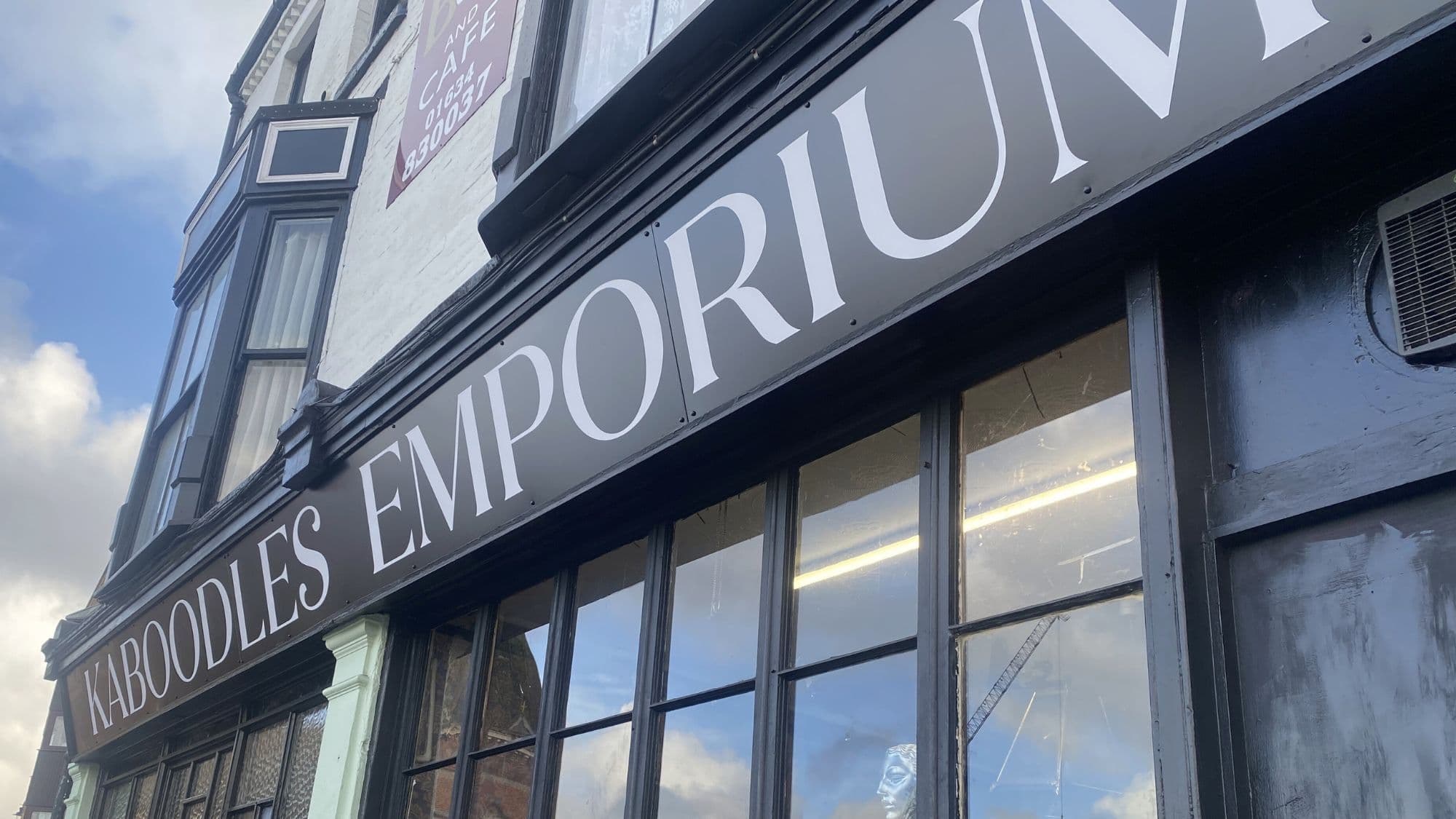
It was here, a few months ago on an early evening walk, that Kaboodles first caught the eye. The shop was closed at the time, the interior dim, but the signage, slightly old-fashioned, held enough presence to make you pause. Through the glass, shapes of objects gathered together suggested something more than a single-purpose shop. It felt like a place to return to.
Today, the timing has aligned. A neon sign in the window spells out OPEN, a quiet invitation rather than a call. A framed chalkboard sits high up against the wall near the entrance, listing the day’s opening hours, and the door is already open.
Stepping inside, it takes a moment for the eyes to settle. There isn’t a single focal point. Instead, every surface carries something. Cabinets, tables and corners, each holding its own collection of objects. Glassware, vintage postcards, silver pieces, toys and small ornaments. Things that don’t belong to any one time or category, but sit comfortably alongside each other.
It becomes clear quite quickly that Kaboodles is not arranged like a typical shop. The space extends further back than first impressions suggest, opening out into more sections. Each one feels slightly different.
Behind the counter, a quiet conversation is taking place. For a moment, it’s unclear whether to interrupt or simply continue browsing. Then a friendly hello cuts through the hesitation, and Kim steps forward from behind the counter with an easy, welcoming smile.
There’s no sense of formality to the exchange. The conversation begins simply, with the familiar explanation of how the shop was first noticed. A passing glance, a return visit, the curiosity of seeing it open this time.
Kim listens with interest, then begins to share a little of her own story.
They opened around eight months ago, she explains, running the space together with Sue and Rosie, the three of them shaping Kaboodles as a shared venture. Before that, she had known the building in a different life, helping out when it was still a charity shop. The continuity seems to matter, not just the space itself, but what it has been part of over time.
She gestures gently around the room.
They call it an antiques emporium. Spaces are rented out to individual traders, with over twenty traders now renting a spot, which explains the shifting atmosphere from one section to another. Each cabinet, each table, each wall reflects a different eye. Some are carefully arranged, others feel more instinctive, as though objects have simply found their place over time.
The effect is subtle but noticeable. You don’t move through the shop with purpose. It’s more about drift, allowing things to catch your eye as you go.
As the conversation continues, it moves away from the shop itself and into the wider shape of the area. Kim speaks about her involvement with local charities and community work, particularly with people experiencing homelessness. There’s a groundedness in the way she talks about it. Not as something separate, but part of everyday life.
There’s a pause as she reflects, then a small shift in tone.
People are often wary, she says, but they’re not so different from anyone else. She mentions a young man she had seen recently, someone who had once been struggling but had since found his footing again in London. It’s a small story, told without emphasis, but it stays with you.
Standing nearby are metal signs, glass displays and trays of silverware. On another table, postcards and old paperbacks sit beside more unusual pieces. The kind of objects that don’t immediately reveal their purpose.
Kim encourages a slower look around.
Somewhere near the counter, she points out a small bird, or what remains of one, its skeletal form still holding traces of feathers. It’s an unexpected object, slightly strange but entirely at home amongst everything else.
The conversation drifts again, this time toward places beyond the shop.
Broomhill Park comes up almost in passing. Kim speaks about it with a familiarity that feels rooted across time. As a child, as a parent and now with grandchildren, it’s somewhere she has returned to repeatedly.
She pauses for a moment, searching for the right word.
“Scrumping,” she says, smiling slightly.
It’s an older term. Taking apples from orchards that were once private land. A small act of mischief, tied to a particular time and place. The memory sits lightly, but it carries a sense of continuity. Of growing up in one place, leaving and eventually finding your way back.
There’s a quiet stillness as she describes it. Not nostalgic in an obvious way, but reflective.
Looking around the shop again, it begins to feel less like a collection of objects and more like a gathering of fragments. Pieces of different lives and different moments, held together within the same space.
Outside, the traffic continues to move through the junction at Star Hill. People cross between Rochester and Chatham without always noticing the shift.
But inside Kaboodles, the pace is different.
It’s a place that reveals itself slowly, not just through what’s on display but through the conversations that unfold within it.